
'Both have a very nationalistic view of foreign policy.' 'They think they are shrewd and clever diplomats.'

As a percentage of the military budget, the navy's share has fallen from 19 per cent in 2010-2011 to just 15.5 per cent this year. With the Indian Navy's annual budget declining steadily, security planners are reluctant to green light crucial projects, discovers Ajai Shukla.

Moon Jae-in's visit will play a crucial role in exploring complementarities between India's Act East policy and South Korea's New Southern policy, says Dr Rahul Mishra.
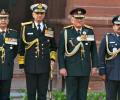
As India's international role expands, so must our capabilities, says Brigadier Gurmeet Kanwal (retd).

Japan could soon be the second country after the US with which India has a logistics support agreement. Besides the LSA, India and Japan may also sign a maritime domain awareness agreement which would enable the two navies to share information. For example, if a Japanese P-1 maritime patrol aircraft detects a Chinese submarine in the Indian Ocean, it would pass on the information to the Indian Navy, reveals Ajai Shukla.

PM Modi articulated five action points that would serve the common interest of promoting peace and prosperity in the Indo-Pacific region.
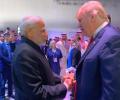
'India will come increasingly in the US crosshairs if it insists on maintaining its strategic autonomy, warns Ambassador M K Bhadrakumar.

An MoU on sharing hydrological information of the Brahmaputra River by China to India and another pact on amendment of the protocol on phytosanitary requirements for exporting rice from India to China to include non-Basmati rice were signed after the Modi-Xi talks in the eastern Chinese port city.

Talking about the Line of Actual Control, Defence Minister Nirmala Sitharaman said as it is not completely demarcated, there are differing perceptions about it by both sides.
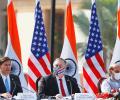
China is now the most significant strategic concern in Washington, as in most of the world's capitals, especially the democracies. Today, strategic autonomy has acquired a sharper definition: To ward off the Chinese challenge to India's territorial integrity, sovereignty and regional stature, observes Shekhar Gupta.
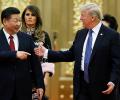
'What matters is that India's perspective on global issues -- climate change, intellectual property, free trade, trade routes being kept free, digital technology -- are listened to with respect,' says Ambassador B S Prakash.
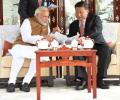
'Till today, we don't know what PM Modi discussed with Xi Jinping and Vladimir Putin, but we have been told that the relations have been reset.' 'We have no evidence from China to show that anything has changed, even though India had made several gestures in preparation for Wuhan,' says Ambassador T P Sreenivasan.

'Clearly, the warming of ties can be a 'win-win' for India and China,' says Ambassador M K Bhadrakumar.
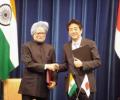
India's commitment to an open and plural security architecture attests to the fact that Asia's transition is a dynamic of both power & identity, says Zorawar Daulet Singh

Prime Minister Narendra Modi enjoys a close relationship with Shinzo Abe. For Abe, "a strong India is in the best interest of Japan, and a strong Japan is in the best interest of India."

In anticipation of a verdict to be delivered by the International Tribunal of the Permanent Court of Arbitration in The Hague on Tuesday, China has orchestrated a worldwide campaign to defuse its findings.

'Notwithstanding the realisation among the Indian leadership to build up its navy for the force's expanding role, the Indian Navy was allocated only 15% of the interim defence budget presented in Parliament in February 2019.' 'The outlay for the navy's capital acquisition is not even adequate to meet its committed liabilities,' points out Brigadier S K Chatterji (retd).

When a Chinese warship entered Japanese waters, the Indian commander called on China to maintain discipline at sea. Dr Rajaram Panda explains the significance of the Malabar exercises between India, Japan and the US.

Had India agreed to join the trade pact, Indian markets would have been flooded with cheap Chinese products.

'It was almost as though there was widespread relief that the defence bureaucracy, and the minister, could find someone willing to shoulder the blame for everything that had gone wrong with the services under Antony's charge -- the poor preparedness of the forces, slow acquisitions caused by indecision, cancellation of contracts and whimsical blacklisting of defence contractors over the tiniest suspicion that they may have paid speed money or kickbacks.'
